Inside the Vathmologia.com Forecasting Engine: Probabilistic Football in Real Time
 Explore Vathmologia
 Why Football Is the Hardest Mainstream Sport to Forecast
Football punishes anyone who tries to predict it. A typical match produces fewer than three goals, so a single moment, a deflection, a penalty, a red card, can overturn ninety minutes of territorial dominance. The better side loses often enough that results alone are a noisy and unreliable signal of strength. Any forecasting system that treats football as the simple problem of naming a winner is fighting the nature of the game itself.
Vathmologia spans the whole game, from Greek football to the Cyprus First Division to competitions around the world, including the 2026 World Cup. That spread is the real challenge. At one end sit major tournaments and big leagues with deep historical data and saturated coverage. At the other sit smaller leagues where the data is thinner and the matchups move quickly. A forecasting engine that works across all of it has to be rich enough to exploit data when it is abundant and disciplined enough to stay honest when it is scarce.
That tension shapes every decision in the model. The goal is not to sound certain. It is to be right about how uncertain each match really is, and to express that uncertainty in numbers a reader can trust.
Probabilities, Not Predictions
The engine never outputs a single answer. For every fixture it produces a full probability distribution: the chance of a home win, a draw or an away win, the likelihood of each exact scoreline, the odds of both teams scoring, and the spread of total goals. A prediction throws information away. A distribution keeps all of it.
The standard the model holds itself to is calibration. When the engine says an outcome has a thirty percent chance, that outcome should happen close to thirty percent of the time across many such calls. Calibration is measurable, it is unforgiving, and it is the difference between a forecasting system and a confident guess. We evaluate it continuously with proper scoring rules, which reward honesty about uncertainty and penalize both timidity and bravado.
This is why Vathmologia speaks in probabilities rather than tips. A well calibrated thirty percent is far more useful than a bold call that feels good in the moment and ages badly by the final whistle.
Team Strength as a Living Quantity
Underneath the forecasts sits a continuously updated estimate of how strong every team is. Strength is not a single number. It is split into an attacking rating and a defensive rating, because a side that scores freely and concedes freely is a very different forecasting problem from a side that grinds out low scoring wins.
These ratings move after every match, weighted so that recent results count for more than old ones. Home advantage is treated as a value the model learns rather than a fixed bonus, because it varies by competition and by team. Margin of victory, quality of opposition and the state of the game all feed the update, so a narrow win over a strong side can lift a rating while a comfortable win over a weak one barely moves it.
The hardest case is the league with little data, and this is where the model earns its keep. Through a hierarchical structure, teams with thin history borrow strength from the wider population of teams they resemble. A newly promoted side in a smaller league is not modeled from a blank slate. Its rating begins near sensible priors and is then allowed to move as real evidence arrives. This partial pooling is what lets the same engine forecast a World Cup heavyweight and a small league newcomer without breaking down at either end.
From Team Strength to Scorelines
Ratings become forecasts through a scoring model. Rather than predict a result directly, the engine models the joint distribution of goals scored by each side, then reads every market off that distribution. Treating the scoreline as the primitive is what keeps the system coherent. The chance of a home win, the over and under lines, both teams to score and the full correct score grid all come from the same underlying object, so they can never contradict each other.
Goals behave almost like a Poisson process, but not quite. Real matches show a dependence between the number of goals each side scores and a well documented excess of low scoring results that a naive model misses. The engine uses a bivariate formulation with a low score correction in the spirit of the Dixon and Coles approach, so draws and tight games carry the weight they truly have rather than the weight a textbook would assume.
From that single scoreline distribution the platform derives the entire menu of probabilities a reader sees, each one consistent with the rest.
The Feature Layer: What the Model Sees
Ratings and scorelines form the skeleton. The flesh is a wide layer of features that sharpen each forecast. Among them are expected goals and shot quality, which describe how a team creates and concedes chances rather than how lucky it has been in front of goal. Recent form, fixture congestion and fatigue, travel, squad availability and likely lineups, set piece tendencies, and the way a team changes behavior when it is ahead or behind all carry signal.
Where reliable market information exists, the engine treats it as one more informative input rather than the final answer. Markets are sharp, but they are not infallible, and a model that simply echoes the odds adds nothing. The aim is to combine the structure of the statistical models with the context of these features into a forecast that is a genuine and defensible view of the match in its own right.
We are deliberate about what we publish. The exact set of features, how they are engineered, how they are weighted, and the precise way they are combined are what give Vathmologia its advantage, and those details stay in house. This article describes the architecture and the science behind the engine. It does not hand over the recipe.
Machine Learning Where It Earns Its Place
Statistical models give the system structure, interpretability and calibration. Machine learning is layered on top to capture the patterns those models cannot express on their own. Gradient boosted ensembles and neural components learn the nonlinear interactions between features, the subtle ways that form, fatigue, personnel and matchup combine that no closed form equation captures cleanly.
The two worlds are joined through ensemble stacking. The statistical base and the learned models each produce a view, and a final blending stage, itself learned and validated on data it has never seen, decides how much to trust each one for a given match. A World Cup fixture with deep history and a thinly covered league game are not blended the same way, and the engine knows the difference.
Discipline matters more than raw power here. Football data is finite and seductive, and it is easy to build a model that explains the past beautifully and forecasts the future poorly. The engine is trained with strict time ordered splits, so it is never allowed to learn from information that would not have existed before kickoff, and it leans on nested validation and regularization to stay honest. A model that looks slightly less impressive in a backtest but holds up on unseen seasons is always the one we ship.
Forecasting Live: Bayesian Updating as the Match Unfolds
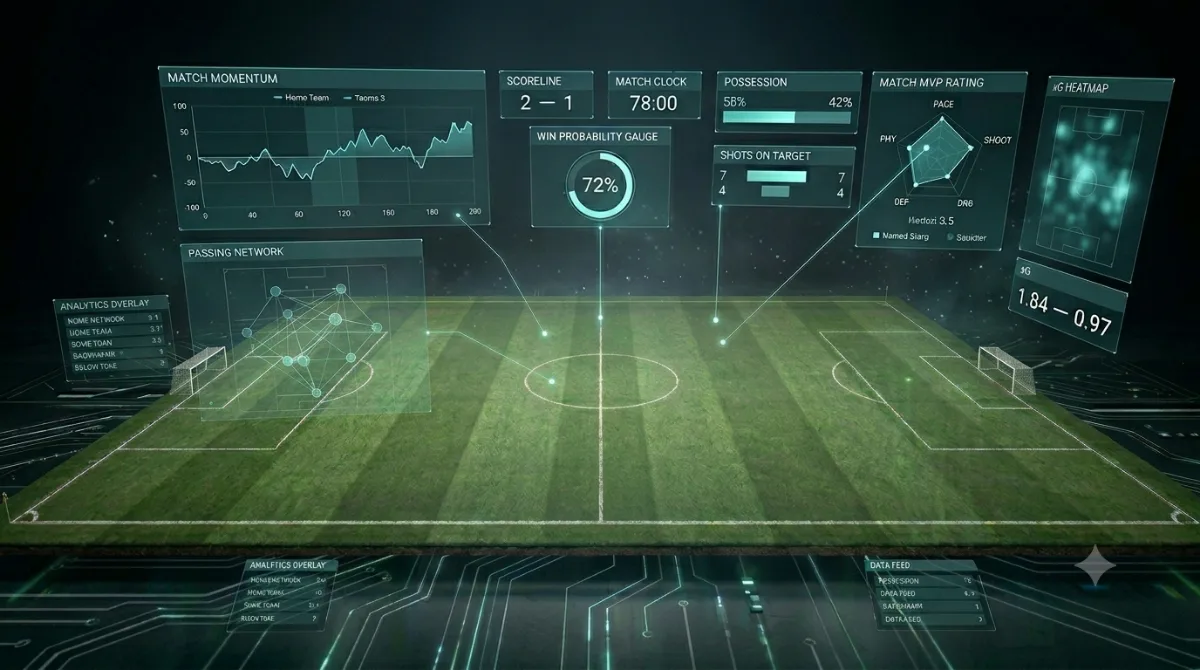
The pre match forecast is only the starting point. The moment a match kicks off, the engine shifts into a live mode where the pre match distribution becomes a prior and every event on the pitch updates it. A goal, a red card, a missed penalty, or simply time ticking away all reshape the probabilities while the match is still being played.
Time is handled with care. Goals are not spread evenly across the ninety minutes, and a one goal lead means something very different in the tenth minute than in the eightieth. The live engine combines the current scoreline, the minute, the state of the game and an intensity model for how goals arrive to keep the forecast current. A side protecting a lead and a side chasing the game imply different futures, and the model follows that rather than freezing its earlier view.
All of this runs on every relevant event with low latency, because a live forecast that lags the match is worthless. The probabilities a reader sees during a game are not a static prediction. They are a continuously revised belief about how the rest of the match will unfold.
Simulation: From Models to Full Distributions
Some of the most useful numbers on Vathmologia cannot be written as a tidy formula, so the engine produces them by simulation. To project the rest of a match, the closing stretch of a season, or an entire tournament, the system plays the relevant games forward thousands of times, drawing each simulated outcome from the distributions the model has built.
Run enough of these simulations and clear probabilities rise out of the noise. For a league it means the chance that each team finishes in a given position, reaches Europe or goes down, read straight from the spread of simulated final tables. For the World Cup it means simulating the group stage and the knockout bracket to estimate how likely each nation is to escape its group or lift the trophy.
Standings projections and tournament odds are not extras bolted on at the end. They fall directly out of the same scoreline level model that drives the single match forecasts, which is why they stay consistent with everything else the platform shows.
Calibration Over Bravado
A forecasting engine is only as good as its record, so the system is judged continuously and without flattery. Every forecast it makes becomes a data point. The model is scored with Brier score and log loss, inspected with reliability diagrams that reveal whether its thirty percent calls really land thirty percent of the time, and backtested on seasons it never trained on.
When the world drifts, and football always does, the engine is built to notice. Changes in scoring trends, a rule adjustment, or a league settling at a new level show up as a decline in the scores, which prompts recalibration rather than quiet decay. The aim is a system that stays honest as the game evolves, not one that was accurate once and then coasts on reputation.
None of this matters if the engine cannot keep up on a busy night. The same system has to stay fast and available when a World Cup match pulls a surge of traffic all at once, so the forecasts are served through a streaming pipeline that recomputes incrementally, caches aggressively and scales out under load, degrading gracefully instead of going dark at the very moment it matters most.
What We Keep Behind the Curtain
We have walked through the shape of the engine: living team ratings with hierarchical pooling, a bivariate scoreline model, a rich feature layer, a machine learning blend, live Bayesian updating, and simulation for everything that cannot be solved in closed form, all held to account by relentless calibration. That is the architecture, and it is genuinely how serious football forecasting is built.
What stays proprietary is everything that turns that architecture into the particular numbers Vathmologia publishes: the exact features and how they are engineered, the parameters, the data sources, the blend weights, and the live tuning refined over many thousands of matches. The science is shared openly. The advantage is not.
To see the engine at work, open the live platform from the link on this page. Vathmologia delivers live scores, standings, fixtures, statistics and real time odds across Greek football, the Cyprus First Division and competitions worldwide, including the 2026 World Cup, with the forecasts moving as the matches unfold.
Looking for help with AI integration, document processing, or intelligent automation?
We build production systems using the patterns and technologies discussed in this article. Tell us about your project.
Get in Touch